Author

admin

Browsing

Frank Holmes of US Global Investors (NASDAQ:GROW) shares his forecast for gold and silver.

He sees gold testing US$5,000 per ounce next year and then reaching US$7,000 by the end of US President Donald Trump’s second term in office.

‘And I think that silver will be over US$100,’ he added.

Securities Disclosure: I, Charlotte McLeod, hold no direct investment interest in any company mentioned in this article.

This post appeared first on investingnews.com

Jennifer Newstead to join Apple as senior vice president, will become general counsel in March 2026

Kate Adams to retire late next year

Lisa Jackson to retire

Apple® today announced that Jennifer Newstead will become Apple’s general counsel on March 1, 2026, following a transition of duties from Kate Adams, who has served as Apple’s general counsel since 2017. She will join Apple as senior vice president in January, reporting to CEO Tim Cook and serving on Apple’s executive team.

In addition, Lisa Jackson, vice president for Environment, Policy, and Social Initiatives, will retire in late January 2026. The Government Affairs organization will transition to Adams, who will oversee the team until her retirement late next year, after which it will be led by Newstead. Newstead’s title will become senior vice president, General Counsel and Government Affairs, reflecting the combining of the two organizations. The Environment and Social Initiatives teams will report to Apple chief operating officer Sabih Khan.

‘Kate has been an integral part of the company for the better part of a decade, having provided critical advice while always advocating on behalf of our customers’ right to privacy and protecting Apple’s right to innovate,’ said Tim Cook, Apple’s CEO. ‘I am incredibly grateful to her for the leadership she has provided, for her remarkable determination across a myriad of highly complex issues, and above all, for her thoughtfulness, her deeply strategic mind, and her sound counsel.’

‘I am deeply appreciative of Lisa’s contributions. She has been instrumental in helping us reduce our global greenhouse emissions by more than 60 percent compared to 2015 levels,’ said Cook. ‘She has also been a critical strategic partner in engaging governments around the world, advocating for the best interests of our users on a myriad of topics, as well as advancing our values, from education and accessibility to privacy and security.’

‘We couldn’t be more pleased to have Jennifer join our team,’ said Cook. ‘She brings an extraordinary depth of experience and skill to the role, and will advance Apple’s important work all over the world. We are also pleased that Jennifer will be overseeing both the Legal and Government Affairs organizations, given the increasing overlap between the work of both teams and her substantial background in international affairs. I know she will be an excellent leader going forward.’

‘I have long admired Apple’s deep focus on innovation and strong commitment to its values, its customers, and to making the world a better place,’ said Newstead. ‘I am honored to join the company and to lead an extraordinary team who are dedicated each and every day to doing what’s in the best interest of Apple’s users.’

‘It has been one of the great privileges of my life to be a part of Apple, where our work has always been about standing up for the values that are the foundation of this great company,’ said Adams. ‘I am proud of the good our wonderful team has done over the past eight years, and I am filled with gratitude for the chance to have made a difference. Jennifer is an exceptional talent and I am confident that I am leaving the team in the very best hands, and I’m really looking forward to working more closely with the Government Affairs team.’

‘Apple is a remarkable company and it has been a true honor to lead such important work here,’ said Jackson. ‘I have been lucky to work with leaders who understand that reducing our environmental impact is not just good for the environment, but good for business, and that we can do well by doing good. And I am incredibly grateful to the teams I’ve had the privilege to lead at Apple, for the innovations they’ve helped create and inspire, and for the advocacy they’ve led on behalf of our users with governments around the world. I have every confidence that Apple will continue to have a profoundly positive impact on the planet and its people.’

Newstead was most recently chief legal officer at Meta and previously served as the legal adviser of the U.S. Department of State, where she led the legal team responsible for advising the Secretary of State on legal issues affecting the conduct of U.S. foreign relations. She held a range of other positions in government earlier in her career as well, including as general counsel of the White House Office of Management and Budget, as a principal deputy assistant attorney general of the Office of Legal Policy at the Department of Justice, as associate White House counsel, and as a law clerk to Justice Stephen Breyer of the U.S. Supreme Court. She also spent a dozen years as partner at Davis Polk & Wardwell LLP, where she advised global corporations on a wide variety of issues. Newstead holds an AB from Harvard University and a JD from Yale Law School.

Apple revolutionized personal technology with the introduction of the Macintosh in 1984. Today, Apple leads the world in innovation with iPhone, iPad, Mac, AirPods, Apple Watch, and Apple Vision Pro. Apple’s six software platforms — iOS, iPadOS, macOS, watchOS, visionOS, and tvOS — provide seamless experiences across all Apple devices and empower people with breakthrough services including the App Store, Apple Music, Apple Pay, iCloud, and Apple TV. Apple’s more than 150,000 employees are dedicated to making the best products on earth and to leaving the world better than we found it.

NOTE TO EDITORS: For additional information visit Apple Newsroom ( www.apple.com/newsroom ), or email Apple’s Media Helpline at media.help@apple.com .

© 2025 Apple Inc. All rights reserved. Apple and the Apple logo are trademarks of Apple. Other company and product names may be trademarks of their respective owners.

View source version on businesswire.com: https://www.businesswire.com/news/home/20251204848925/en/

Josh Rosenstock
Apple
jrosenstock@apple.com

News Provided by Business Wire via QuoteMedia

This post appeared first on investingnews.com

Silver is known as the most versatile precious metal, and its end uses range from silverware to medicine, as well as industrial and technological applications, which account for well over half of annual global demand.

In 2024, global physical silver demand reached 1.16 billion ounces, shy of the record of 1.28 billion ounces set in 2022, as per the Silver Institute’s latest World Silver Survey released in April 2025.

Industrial demand is on an upward trend from the push toward renewable energy — in particular, silver demand should benefit from the expansion of the solar energy sector, electric vehicles and the growing use of AI and data centers. The metal is a great conductor of both heat and electricity, making it perfect for use in solar panels.

In 2025, the Silver Institute expects global demand for silver to decline by 1 percent to 1.15 billion ounces, but remain at historically high levels. With all of that in mind, here’s a look at four factors driving silver demand.

1. Industrial fabrication

Expected demand in 2025: 677.4 million ounces

Silver is the best electrical and thermal conductor of all the metals, so it’s no surprise that it’s used in industrial fabrication. Industrial silver demand has seen steady growth in recent years. Coming in at just 491 million ounces in 2016, industrial demand rose to 592.3 million ounces in 2022, 657.1 million ounces in 2023 and a record 680.5 million ounces in 2024.

For 2025, the Silver Institute believes industrial demand will see a slight regression of 0.5 percent to 677.4 million ounces.

Here’s a brief rundown of the main industrial uses driving silver demand:

Electronics — In electronics, industrial silver is used mainly in multi-layer ceramic capacitors, membrane switches, silvered film, electrically heated automobile windshields, conductive adhesives and the preparation of thick-film pastes.

Electronics is expected to remain an important driver for silver going forward, as per the Silver Institute, which expects overall industrial silver consumption to reach 456.6 million ounces in 2025. Photovoltaics form the largest portion of electronic demand, totaling 197.6 million tons in 2024.

Using silver as conductive ink, photovoltaic cells transform sunlight into electricity. These cells are combined to form solar panels. The use of silver in the fabrication of photovoltaic cells, also known as solar cells, is seen as an area of rapid growth in the short to medium term. In fact, SolarPower Europe reported that total installations reached 2.2 terawatts by the end of 2024, and are expected to more than triple to more than 7 terawatts by 2030.

Automotive industry — Every electrical action in a modern car is activated with silver-coated contacts. Basic functions such as starting the engine, opening power windows, adjusting power seats and closing power trunks are all activated using a silver membrane switch. Furthermore, in January 2021, the Silver Institute reported that, depending on the model, battery electric vehicles contain between 25 and 50 grams of silver, while hybrid vehicles use 18 to 34 grams of silver. That’s compared to 15 to 28 grams of silver in a light internal combustion engine vehicle.

The Silver Institute has projected that automotive demand for silver could reach 90 million ounces by 2025. The association states that silver demand from the car industry will be driven by infrastructure investment, broader decarbonization efforts and the expansion of charging stations.

Brazing and soldering — Adding silver to the process of soldering or brazing helps produce smooth, leak-tight and corrosion-resistant joints when combining metal parts. In addition, silver-brazing alloys are used widely in everything from air conditioning and refrigeration to electric power distribution. The Silver Institute predicts demand from this segment to total 52.9 million ounces in 2025.

2. Jewelry

Expected demand in 2025: 196.2 million ounces

Jewelry is often what laypeople think about when they consider silver demand. And for good reason — few materials are better suited for jewelry than silver. Lustrous but resilient, silver responds well to sculpting, requires minimal care and lasts a lifetime.

While silver and gold possess similar working qualities, the white metal enjoys greater reflectivity and can achieve a brilliant polish. A vast amount of silver supply from mine production gets turned into a form of jewelry. The segment grew moderately by 3 percent in 2024, rising to 208.7 million ounces, but the Silver Institute is predicting a significant reversal in 2025, with a 6 percent decline to 196.2 million ounces.

3. Silver bullion, coins and bars

Expected demand in 2025: 204.4 million ounces

Another source of silver demand is for silver as an investment in the form of silver coins, bars and rounds. This category includes the silver used to fabricate the bullion, as well as small bar purchases by retail investors, according to the Silver Institute.

Silver coins have a long history. Minted silver coins were first used in the Eastern Mediterranean region in 550 BCE, and by 269 BCE the Roman Empire had adopted silver as well. Silver was the main circulating currency until the 19th century, when it was phased out of regular coinage.

While silver is not used in many circulating coins today, mints in many countries still create high-purity bullion coins and bars for investors.

Physical silver investment demand reached a record high of 338.3 million ounces in 2022, but declined considerably to 244.3 million ounces in 2023, before falling another 22 percent to 190.9 million ounces in 2024.

However, with rising uncertainty in global financial markets, the institute is predicting 7 percent growth in 2025 to 204.4 million ounces.

Silver exchange-traded products (ETPs) and silver ETFs purchase significant amounts of physical silver. Silver ETPs have experienced high volatility over the last five years, with demand peaking in 2020 with net inflows of 331.1 million ounces of silver, which fell to to 64.9 million ounces in 2021. Following the pandemic, ETPs experienced heavy outflows with investors selling off 117.4 million ounces in 2022 and 37.6 million ounces in 2023.

In 2024, as uncertainty began to seep into global financial markets, investors once again returned to ETPs, pushing demand to 61.6 million ounces of silver flowing into the products.

The Silver Institute expects demand to grow by 14 percent in 2025 to 70 million ounces, attributing these inflows to cuts to the Federal Funds rate, concerns over US debt load, and instability in the Middle East.

4. Silverware

Expected demand in 2025: 46 million ounces

Sterling silver has been the standard for silver holloware and silver flatware since the 14th century. Silver cutlery and other decor lasts for generations as it resists tarnish and is a traditional decoration in homes around the world. Base metal copper is mixed with silver to strengthen it for use as cutlery, bowls and decorative items.

Demand for the metal from the silverware industry reached 73.5 million ounces in 2022 but has declined since then to 54.2 million ounces in 2024. The Silver Institute expects the market to shed another 15 percent in 2025 to 46 million ounces.

Securities Disclosure: I, Melissa Pistilli, hold no direct investment interest in any company mentioned in this article.

This post appeared first on investingnews.com

Kingsmen Resources Ltd. (TSXV: KNG,OTC:KNGRF) (OTCQB: KNGRF) (FSE: TUY) (‘Kingsmen’ or the ‘Company’) is pleased to report first assays from hole LC-25-008 that intersected significant new gold rich silver mineralization. This hole was drilled 160 meters from the previously reported high grade silver discovery of 1,028 gt silver equivalent over 1.45 meters (455 gt silver) from 190.25-191.70m including 1,742 gt silver equivalent over 0.70 meters (770 gt silver) from 190.85- 191.55m in hole LC-25-010 (see news release September of 24, 2025). These holes were drilled as part of the recently completed 12 hole 3,227.2 meter drill program on its 100% owned Las Coloradas silver project. The Las Coloradas project is in the Parral mining district of the Central Mexican Silver Belt, Chihuahua Mexico.

Four Key Highlights:

  1. HIGH GRADE SILVER DISCOVERY
    1. * 931 g/t silver equivalent with 1.28 g/t gold over 1.60 meters (521 g/t silver) from 156.4-158.0m.
    2. * Gold rich mineralization.

  2. NEW DISCOVERY – WIDE MINERALIZED ZONE
    1. *200 g/t silver equivalent & 0.28 g/t gold over 10.50 meters (97.4 g/t silver) from 154.5-165.0m.
    2. *New silver-gold target.
    3. * Hole drilled 160 meters from high grade hole LC-25-010.

  3. SHALLOW, NEAR-SURFACE MINERALIZATION
    1. Mineralization starts at approximately 135 meters vertical depth.
    2. *Multiple mineralization styles including massive sulphides.
    3. * Strong pathfinder elements (antimony, indium, bismuth, and tellurium) indicate larger system.
  4. SIGNIFICANT DISCOVERY POTENTIAL
    1. Less than 5% of property explored.
    2. *8.5 km2 consolidated historic mining district.
    3. *Multiple untested structures and veins.
    4. *Located in Mexico’s prolific Parral Silver District.

President, Scott Emerson commented, ‘The gold rich silver mineralization intersected in this hole is an exciting discovery on a previously unknown structure. The mineralized intercepts in this hole and hole LC-25-010 are significantly wider than those historically reported and mined by ASARCO for the Soledad mineralization. This new discovery, potentially adds a 3rd structure in what is a new area and the gold values significantly enhance the value of the mineralization. This mineralization is believed to be similar to that of the old La Prieta mine whose tailings are being reprocessed at GoGold’s, Parral operation. In addition, it opens the potential for additional significant discoveries in, to-date, untested structures which can be mapped at surface.’

Vice President of Exploration, Kieran Downes Ph.D., P.Geo. noted ‘The property continues to deliver exciting and promising results that show the potential for additional, new high-grade discoveries. There are many kilometers of veins/structures, all of which are prospective especially where dilatant zones for mineralization may be created by changes in attitude, splays, lithologic contacts and intersections. The shape of the mineralization may vary from simple vein to chimney to manto. The role of the intrusion intersected at depth, if any, will be evaluated in conjunction with the receipt of assays.’

Hole LC-25-008 was drilled to test two separate targets.

  • Target 1 was the intersection of a NE-trending vein/structure with a flexure/cymoid curve in a NW-trending vein/structure at the margin of a magnetic high (Figures 1 and 2). The flexure is approximately 400 meters long and may have may have created a dilatant zone(s) in Target 1 and beyond. The hole bottomed in intrusive confirming the interpretation of the magnetics. Target 1 returned the significant intersection reported here (Table 1).
  • Target 2 was the intersection of NW-trending and NE-trending structures/vein systems, in an area of high chargeability and resistivity, at the margin of a magnetic high/intrusive (Figure 2). Assays are pending.

Hole LC-25-008 (Table 1; Table 2; Table 3) intersected an alteration zone with massive sulphide mineralization from approximately 154.5 to 165.0 meters (10.50 meters) downhole. The silver rich massive sulphide mineralization comprises sphalerite, galena, arsenopyrite, and pyrite (Figure 3 and 4). The mineralization is strongly anomalous in pathfinder elements antimony, bismuth, indium, arsenic and tellurium (Table 1). Silver values vary with galena-sphalerite content. Significant gold is associated with the high-grade silver mineralization and varies with the arsenopyrite content. Of note is the presence of associated elevated to anomalous tellurium, a significant indicator of gold mineralization. The mineralization exhibits late-stage faulting and brecciation. The hole bottomed in a fine to medium grained feldspar porphyry carrying disseminated pyrite confirming the interpretation of the magnetics.

The mineralized zone has a brecciated section from 155.95 to 157.0 meters composed of translucent quartz veins, white quartz, and masses of sulfides arranged in a stockwork. Sphalerite predominates with pyrite, smaller amounts of galena and arsenopyrite are also present. Arsenopyrite predominates in the quartz veining. From 157.0 to 158.45 m, there is a cavity with clusters of arsenopyrite, pyrite, galena, sphalerite and druses with prismatic quartz and possibly jamesonite crystals. The host rocks are sediments displaying moderate shear deformation, intense green chloritic alteration and silicification.

Table 1 Analyses

Hole From To Width Au ppm Ag ppm As ppm Bi ppm Cu ppm In ppm Pb ppm Sb ppm Te ppm Zn ppm
LC-25-008 143.60 144.40 0.80 0.005 1.2 548 1.5 18.1 0.974 121 17.85 0 2800
LC-25-008 144.40 144.80 0.40 0.005 1.48 499 1.72 13.4 0.93 194 5.45 0 2110
LC-25-008 144.80 145.20 0.40 0.006 1.4 572 1.57 13.4 0.152 175 3.07 0.05 194
LC-25-008 145.20 146.00 0.80 0.005 0.69 183.5 0.81 19.1 0.066 79 2.49 0 93
LC-25-008 146.00 147.00 1.00 0.005 1.44 136 2.48 19.5 0.388 76 1.78 0 921
LC-25-008 147.00 147.40 0.40 0.008 2 589 5.56 18 1.31 92 3.99 0.1 6570
LC-25-008 147.40 148.00 0.60 0 0.58 71.1 1.16 20 0.049 23 1.17 0 105
LC-25-008 148.00 149.00 1.00 0 0.58 88 1.02 24.1 0.056 33 3.33 0 86
LC-25-008 149.00 150.00 1.00 0 0.88 176.5 1.36 22.9 0.087 74 4.03 0 138
LC-25-008 150.00 151.00 1.00 0 0.94 96.3 1.68 28.6 0.069 39 2.19 0 104
LC-25-008 151.00 151.60 0.60 0.005 1.18 144 1.8 23.5 0.111 112 8.1 0 274
LC-25-008 151.60 152.30 0.70 0 0.75 80.7 1.5 30.8 0.07 39 1.86 0 133
LC-25-008 152.30 153.00 0.70 0 0.65 148.5 0.94 20.4 0.154 44 2.56 0 214
LC-25-008 153.00 153.50 0.50 0 0.66 51.9 1.14 21.7 0.033 36 2.18 0 58
LC-25-008 153.50 154.00 0.50 0.007 1.62 425 2 31.4 1.1 154 4.6 0 3210
LC-25-008 154.00 154.50 0.50 0 1.16 244 0.93 21.1 0.135 112 12.65 0 126
LC-25-008 154.50 155.00 0.50 0.007 14.1 446 4.28 23.4 1.77 2490 34 0.26 1895
LC-25-008 155.00 155.50 0.50 0.009 8.91 866 3.45 26.9 1.06 1420 23.4 0.19 1260
LC-25-008 155.50 155.95 0.45 0.015 23.3 2200 14.1 32.6 4.91 3780 87.9 1.09 8090
LC-25-008 155.95 156.20 0.25 0.077 395 >10000 400 141 86.9 61400 296 18.25 123000
LC-25-008 156.20 156.40 0.20 0.051 70 >10000 48.1 39.7 8.51 11500 64.3 2.46 18650
LC-25-008 156.40 156.70 0.30 0.169 968 >10000 771 208 169 154000 2640 20.6 250000
LC-25-008 156.70 157.00 0.30 0.569 568 >10000 359 48.5 21.2 108000 708 11.7 30100
LC-25-008 157.00 158.00 1.00 1.825 373 >10000 525 119.5 59.5 71700 9640 16.7 100500
LC-25-008 158.00 158.45 0.45 1.62 69.1 >10000 227 9 2.44 3050 1085 7.5 3990
LC-25-008 158.45 159.00 0.55 0.047 6.2 >10000 19.65 5.7 0.697 501 134.5 0.24 1320
LC-25-008 159.00 159.55 0.55 0.206 11.9 >10000 61.5 10.4 1.145 1405 672 1.48 3030
LC-25-008 159.55 160.20 0.65 0.007 4.13 252 2 18.6 0.215 60 29.3 0 308
LC-25-008 160.20 160.90 0.70 0.015 2.62 845 2.66 18.6 1.025 104 31.2 0 3040
LC-25-008 160.90 161.50 0.60 0 0.53 85 1.07 22.6 0.059 30 28.8 0 110
LC-25-008 161.50 162.50 1.00 0.011 2.46 342 15.35 26.2 0.531 62 34.1 0 2580
LC-25-008 162.50 163.00 0.50 0.024 1.94 77.2 1.56 18.8 0.178 22 22.4 0 128
LC-25-008 163.00 164.00 1.00 0.013 2.1 1060 2.98 23.6 0.169 32 21 0 441
LC-25-008 164.00 165.00 1.00 0.017 3.27 574 2.59 23.6 0.172 37 33.2 0 91
LC-25-008 165.00 165.50 0.50 0.015 0.99 863 0.84 15.4 0.215 18.8 21.5 0.07 65
LC-25-008 165.50 166.60 1.10 0 0.64 87.7 2.79 20.2 0.028 26.5 12.35 0 63​

True width cannot be determined at this time and reported widths are drilled intervals.

Table 2 Silver equivalents

Hole From To Width(m) Ag Eq ppm Ag ppm Au ppm Pb% Zn%
LC-25-008 154.50 165.00 10.50 200 97.4 0.28 1.66 2.22
incl 155.95 159.55 3.60 496 274 0.81 4.81 6.26
incl 155.50 158.45 2.95 623 355 0.95 5.79 7.61
incl 155.50 158.00 2.50 688 383 0.83 6.78 8.9
incl 156.40 158.00 1.60 931 521 1.28 9.39 11.53​

The silver equivalent calculation formula is AgEq(g/t) = ((Ag grade (g/t) x (Ag price per ounce/31.10348) x Ag recovery) + (Pb grade (%) x (Pb price per tonne/100) x Pb recovery) + (Zn grade (%) x (Zn price per tonne/100) x Zn recovery) + (Au grade (g/t) x (Au price per ounce/31.10348) x Au recovery)) / (Ag price per ounce/31.10348 x Ag recovery). The prices used were US$3675/oz gold, US$2960/t zinc, US$2003/t lead and US$42/oz silver. Recoveries are estimated at 40% for gold, 91% for lead, 85% for zinc and 92% for silver based on published figures by Kootenay Silver Inc. for sulphide mineralization in the Cigarra deposit, Chihuahua, Mexico, a deposit with similar style mineralization (https://kootenaysilver.com/news/kootenay/2024/kootenay-silver-announces-updated-mineral-resource-estimate-for-la-cigarra-project-chihuahua-mexico).

Table 3 Collar and survey table

Hole_ID Easting Northing Elevation Az Dip EOH
LC-25-001 464675 2964907 1630 185 -50 594.00
LC-25-002 464161 2964857 1634 190 -50 201.00
LC-25-003 464161 2964857 1634 190 -70 200.35
LC-25-004 464122 2964879 1634 200 -45 203.45
LC-25-005 464770 2964455 1661 220 -60 248.45
LC-25-006 464804 2964418 1660 220 -60 152.85
LC-25-007 464731 2964485 1662 220 -60 167.60
LC-25-008 464731 2964485 1660 337 -70 506.80
LC-25-009 464669 2964549 1660 220 -75 215.65
LC-25-010 464864 2964572 1651 220 -45 269.45
LC-25-011 464669 2964549 1660 250 -45 315.80
LC-25-012 463522 2964744 1640 45 -45 151.80

Figure 1

To view an enhanced version of this graphic, please visit:
https://images.newsfilecorp.com/files/9640/276747_0124ba7af4384ae1_009full.jpg

Figure 2

To view an enhanced version of this graphic, please visit:
https://images.newsfilecorp.com/files/9640/276747_0124ba7af4384ae1_010full.jpg

Figure 3 Mineralization

To view an enhanced version of this graphic, please visit:
https://images.newsfilecorp.com/files/9640/276747_0124ba7af4384ae1_011full.jpg

Figure 4 Mineralization (part) – split core

To view an enhanced version of this graphic, please visit:
https://images.newsfilecorp.com/files/9640/276747_0124ba7af4384ae1_012full.jpg

Holes 5, 6, 7 and 10 tested a 100-meter length of the Soledad system centered on the Soledad shaft. Holes 9 and 11 tested the structure in the area of the Rosario shaft. Holes 2, 3 and 4 tested a 50-meter segment of the Soledad structure/vein system in the DBD target. Hole 12 tested under old workings on the Soledad II structure/vein system. Holes1 and 8 tested a geological/geophysical target. The target was the intersection of NW-trending and NE-trending structures/vein systems, in an area of high chargeability and resistivity on an interpreted NW-trending magnetic structure.

QAQC
The drill core (HQ size) was geologically logged and sampled. The full drill core was sawn with a diamond blade rock saw. One half of the sawn drill core was bagged and tagged for analysis. The remaining half portion was returned to the drill core tray and stored. Bagged samples are securely stored prior to submission for analysis. Samples were submitted to ALS Geochemistry-Chihuahua for multielement analysis following four-acid digestion (code ME-MS61), and gold by fire assay-AA (code Au-AA23). Quality assurance and quality control (QA/QC) is maintained by the systematic insertion of certified standard reference materials (CSRM), blanks and duplicates into the sample stream. Assay results will be announced following receipt, compilation and confirmation. ALS Geochemistry operates under a Global Geochemistry Quality Manual that complies with ISO/IEC 17025:2017.

About Las Coloradas
The Las Coloradas Project (8.5 km2 -3.3 sq miles) represents a consolidation of a historic mining district which covers numerous silver-gold-lead-zinc-copper mines previously exploited by ASARCO (American Smelting and Refining Company), the U.S. based subsidiary of Grupo Mexico.

Las Coloradas is in the Parral mining district of the Central Mexican Silver Belt, and is located approximately 30 kilometers southeast of the city of Hidalgo de Parral and 40 kilometers east of the San Francisco de Oro and Santa Barbara mining districts where several old major mines are located, such as La Prieta, Veta Colorada, Palmilla, Esmeralda, San Francisco del Oro and Santa Barbara. Click here to see locator map: https://www.kingsmenresources.com/area-history

Qualified Person
Kieran Downes, Ph.D., P.Geo., a director of Kingsmen and Qualified Person as defined by National Instrument 43-101, has reviewed and approved the scientific and technical disclosure set out in this news release.

About Kingsmen Resources
Kingsmen Resources is a mineral exploration company focused on advancing its 100% held projects, the Las Coloradas silver/gold project and Almoloya gold/silver project located in the prolific mining district of Parral Mexico. The projects host historic past producing high-grade silver mines. They are considered to be prospective for hosting further precious metal deposits, being on the same structural and stratigraphic belts that host numerous other, on-trend, high-grade deposits. In addition, the company has a 1% NSR on the La Trini claims which form part of the Los Ricos North project operated by GoGold Resources Inc. in Mexico. Kingsmen is a publicly-traded company (TSXV: KNG,OTC:KNGRF) (OTCQB: KNGRF) (FSE: TUY) and is headquartered in Vancouver, British Columbia.

On behalf of the Board,

Signed: ‘Scott Emerson

Scott Emerson, President & CEO
Phone: 6046859316
Email: se@kingsmenresources.com
Follow us on: LinkedIn, Instagram and X

Neither the TSX Venture Exchange nor its Regulation Services Provider (as that term is defined in the policies of the TSX Venture Exchange) accepts responsibility for the adequacy or accuracy of this release.

Forward-Looking Statements:

Certain disclosure contained in this news release may constitute forward-looking information or forward-looking statements, within the meaning of Canadian securities laws. These statements may relate to this news release and other matters identified in the Company’s public filings. In making the forward-looking statements the Company has applied certain factors and assumptions that are based on the Company’s current beliefs as well as assumptions made by and information currently available to the Company. These statements address future events and conditions and, as such, involve known and unknown risks, uncertainties and other factors which may cause the actual results, performance or achievements to be materially different from any future results, performance or achievements expressed or implied by the statements. These risks and uncertainties include but are not limited to: the political environment in which the Company operates continuing to support the development and operation of mining projects; the threat associated with outbreaks of viruses and infectious diseases; risks related to negative publicity with respect to the Company or the mining industry in general; planned work programs; permitting; and community relations. Readers are cautioned not to place undue reliance on forward-looking statements. The Company does not intend, and expressly disclaims any intention or obligation to, update or revise any forward-looking statements whether as a result of new information, future events or otherwise, except as required by law.

To view the source version of this press release, please visit https://www.newsfilecorp.com/release/276747


News Provided by Newsfile via QuoteMedia

This post appeared first on investingnews.com

As gold and silver continue to prove their worth as sound investments, market participants should know how capital gains taxes are calculated for precious metals investments in the US.

While the majority of gold and silver investing comes with a certain degree of taxation, there are different levels of capital gains taxes based on how market participants decide to invest in these precious metals, how long the investments are held for and the investor’s individual tax bracket.

Read on for a breakdown of capital gains taxes associated with investing in gold and silver bullion, ETFs and stocks, as well as the forms involved with reporting precious metals investments.

In this article

    How are capital gains from gold and silver bullion taxed?

    Gold and silver bullion, coins and bars are seen as collectibles by the Internal Revenue Service (IRS) in the US. Thus, physical gold and physical silver, no matter the form, are subject to a higher rate of capital gains tax when they are sold. The same is true for fellow precious metals platinum and palladium.

    While long-term capital gains would typically carry a top bracket of 20 percent, collectibles can be taxed at a higher 28 percent.

    The total an investor will owe in capital gains tax when selling gold and silver bullion is based both on their income bracket and the length of time they held the asset.

    The long-term capital gains tax on physical gold and silver is equal to an investor’s marginal tax rate, up to a maximum of 28 percent due to their status as a collectible, meaning those in higher tax brackets still only have to pay 28 percent on long-term gains from physical precious metals sales.

    It is worth noting that the 28 percent maximum is only for long-term capital gains, which applies to metals that an investor has held for more than one year. Short-term capital gains on precious metals held for less than one year are taxed at ordinary income rates.

    For example, a person in the highest tax bracket purchased 100 ounces of physical gold at US$1,800 per ounce and two years later sold their holdings for US$2,000 per ounce. While they are in the 37 percent tax bracket, they would pay 28 percent tax on the capital gains made from these sales. As they earned US$20,000 in capital gains, that would translate to US$5,600 in income tax.

    However, if the investor sold the gold at the same gain just 11 months after they purchased it, it would count as short-term capital gains, and the investor would be taxed at 37 percent and owe US$7,400.

    Investors who are in one of the tax brackets below 28 percent are taxed at the standard rate of their bracket when selling their solid gold and silver assets, whether they are held short- or long-term.

    Similarly to other investments, precious metals sold at a loss can be used to offset capital gains.

    How are capital gains from gold ETFs and silver ETFs taxed?

    In terms of taxation, capital gain taxes from selling gold ETFs and silver ETFs can vary significantly based on the ETF’s holdings, the investor’s tax bracket and how long they held the asset for.

    Funds will often supply investors with tax forms that they can use to fill out their income tax. The webpage for a fund should have a document describing how income tax is handled for that fund, which is worth reading before investing in it.

    There are two main types of gold and silver ETFs: those that track the prices of precious metals and those that track gold or silver stocks.

    ETFs that follow metals prices hold either bullion, or gold or silver futures contracts. It is important to keep in mind that investing in these ETF platforms does not allow investors to redeem gold or silver bullion, with few exceptions.

    ETFs that invest in gold or silver companies provide hold gold and silver mining stocks, as well as precious metals royalty and streaming stocks.

    So how much are investors taxed for capital gains on precious metals ETFs?

    As mentioned above, it depends on the length they are held; short-term capital gains taxes apply to assets held less than one year, and long-term capital gains taxes apply to those held over one year.

    Short-term capital gains made from selling gold or silver ETFs that hold physical metals or mining stocks will be taxed at the investor’s tax bracket, up to a maximum federal rate of 37 percent.

    Long-term capital gains from selling gold and silver ETFs that hold stocks are capped at a 20 percent maximum federal income tax rate, because ETFs that hold stocks are taxed in the same way as traditional securities, which you can read more about in the following section.

    Regarding gold and silver ETFs that hold physical metals, long-term capital gains from selling shares of these are subject to a 28 percent maximum rate because the holdings are considered collectibles, meaning they are taxed at the same rate as bullion as described in the section above.

    Capital gains on futures-based commodity ETFs can often differ significantly from the others, as they can come with their own set of rules that you can learn about here. Briefly, futures ETFs are often taxed in a 60/40 hybrid, with 60 percent treated as long-term gains and 40 percent treated as short-term gains. Additionally, this is calculated at the end of each tax year, whether a sale is made or not.

    Lastly, short-term and long-term capital gains on any ETFs could be subject to a 3.8 percent net investment income tax for high net-worth investors, and a state income tax may also apply.

    How are capital gains from gold and silver stocks taxed?

    In terms of tax on gold stocks and silver stocks, long-term gains from selling are subject to the standard 20 percent maximum federal rate, while short-term gains will face a maximum federal rate of 37 percent.

    For investors in higher income brackets, there is the potential for gold and silver stock investments to also be hit with the 3.8 percent net investment income tax as well as state income tax.

    Unlike physical precious metals and ETFs that hold them, precious metals stocks are not classified as collectibles, which is why the long-term capital gains tax is capped at 20 percent instead of 28 percent.

    Stocks sold at a loss are important as well as they can be used to offset capital gains when filing income tax.

    How to report taxes on physical gold and silver investments

    Market participants who sell precious metals bullion in the US for a profit are required to report that profit on their income tax return, regardless of whether or not the dealer has any reporting obligation.

    When selling gold and silver coins and bars in the US, there are two different sets of reporting guidelines — one applies to the dealer through which a person sells and the other applies to the investor who is selling the asset.

    It is important to note that taxes on the sale of gold and silver will not be due the moment that the sale is made, and the tax bill for all of these sales is due at the same time as a standard income tax bill.

    For investors selling precious metals, capital gains or losses need to be reported on Schedule D of Form 1040 when making a tax return.

    Investors will first need to detail their precious metals transactions on Form 8949, including the length of time the investments were held. This form must be filed alongside Schedule D. Investors then use this information alongside the 28% Rate Gain Worksheet included in the Schedule D instructions.

    Depending on the type of metal being sold, Form 1099-B may have to be submitted to the IRS by the broker when the sale closes, as such transactions are considered income. As for when a broker will need to file Form 1099-B, there are specific rules that determine which sales of precious metals require the dealer to file this form that apply to transactions over a 24 hours period.

    For gold sales, reportable items include specific gold coins, including the 1 ounce Canadian Gold Maple Leaf and Gold Krugerrand, and gold bars and rounds of at least 0.995 fineness. As for quantity, only sales of more than 25 gold coins and or more than 1 kilogram in gold bars and rounds will require the form.

    Sales of 0.999 fine silver bars and rounds totaling over 1,000 ounces are reportable. For silver coins, US coins with above 90 percent silver are reportable, but Silver American Eagle coins are not. Sales of silver coins exceeding US$1,000 will require a form.

    When it comes to selling gold and silver overseas, market participants must follow the laws as they apply to the sale of gold and silver investments in that particular country.

    The information in this article does not constitute tax advice, and investors should work with a tax professional or program to help them make sure everything is reported accurately.

    FAQs for capital gains taxes on precious metals

    Do you pay capital gains tax on gold?

    Yes, US investors selling gold coins, bars and other bullion will be taxed on any capital gains made from those sales when reporting their income tax, with the tax rate dependent on whether the precious metals were held short-term or long-term and their tax bracket.

    Are precious metals subject to capital gains tax?

    Yes, sales of precious metals coins, bars and ETFs are subject to capital gains tax at varying rates. Because of this, you have to report gains and losses from precious metals on your income tax.

    Are gold coins and bars exempt from capital gains taxes?

    No, gold coins and gold bars are not exempt from capital gains taxes, meaning investors who sell their precious metals bullion must declare capital gains and capital losses on their income tax.

    Securities Disclosure: I, Lauren Kelly, currently hold no direct investment interest in any company mentioned in this article.

    The information in this article does not constitute tax advice, and investors should work with a tax professional or program to help them make sure everything is reported accurately.

    This post appeared first on investingnews.com

    USANewsGroup .com Market Intelligence Brief Efficient Market Theory often fails in the small-cap sector. In this space, price discovery is slow. It lags behind the news. This creates a ‘valuation disconnect’ where a company’s fundamental reality has shifted but the ticker remains anchored to an old story.

    For the disciplined investor, this lag is the signal.

    The following report analyzes five specific case studies of this phenomenon. We look at an immunotherapy priced as if its clinical wins never happened, an FDA-cleared AI platform valued as a hardware vendor, a permitted developer priced as an explorer, a US uranium validator priced as a grassroots hunter, and a strategic defense asset hidden inside a gold discovery. In each case, we believe the operational pivot has already occurred. The market, however, appears to lag behind the new information.

    1. Oncolytics Biotech Inc.
    TICKER: (NASDAQ: ONCY)
    SECTOR: Immunotherapy / Oncology
    THE DISCONNECT: The market is pricing ONCY as another failed immunotherapy play. The reality: pelareorep is the activator designed to enable Big Pharma’s patent-cliff checkpoint inhibitors to target cancers where they currently struggle.
    THE CATALYST: FDA-aligned Phase 3 trial initiation in first-line pancreatic cancer; the only immunotherapy registration study planned for this indication.
    MARKET CONTEXT: Pelareorep doesn’t compete with Merck’s Keytruda or Roche’s Tecentriq. It primes tumors to unlock more potential efficacy from those drugs.
    THE INTELLIGENCE BRIEF:
    Oncolytics secured FDA alignment on a three-arm Phase 3 design testing pelareorep plus chemotherapy, with and without checkpoint inhibitors. The justification: a 62% objective response rate in pancreatic cancer when pelareorep was added to chemo and a checkpoint inhibitor, in a disease where immunotherapy has zero approved regimens. Two-year survival hit 21.9% versus the 9.2% historical standard.
    The mechanism is elegant. Pelareorep replicates inside cancer cells, triggering immune activation that converts ‘cold’ tumors ‘hot.’ Recent anal cancer data showed 30% response rates (double the FDA-approved benchmark) with complete responses lasting beyond two years. Big Pharma’s problem: their checkpoint inhibitors only work in 20-30% of cancers. Pelareorep expands that addressable market.
    Management pedigree matters here. CEO Jared Kelly and CBO Andrew Aromando engineered Ambrx’s $2 billion sale to J&J . Site activation is underway. Once enrollment numbers hit, the valuation gap becomes impossible to ignore.

    CONTINUED… Read this and more news for Oncolytics Biotech at: https://usanewsgroup.com/2023/10/02/the-most-undervalued-oncolytics-company-on-the-nasdaq/

    2. Lake Victoria Gold
    TICKER: (TSXV: LVG) / (OTCQB: LVGLF)
    SECTOR: Precious Metals / Production & Development
    THE DISCONNECT: The market prices LVG as a grassroots explorer stuck in permitting purgatory. The reality: Imwelo is a fully permitted mine development project with construction capital in hand, sitting 12 kilometers from AngloGold Ashanti’s flagship Geita operation.
    THE CATALYST: November drilling results confirmed gold mineralization extends 50 meters below the planned pit shell, pushing vertical depth past 250m and shattering the historical 200m resource boundary.
    MARKET CONTEXT: This isn’t another speculative junior. Barrick Gold already recognized the district potential, acquiring LVG’s Tembo licenses under an Asset Purchase Agreement that locks LVG into up to $45 million in contingent milestone payments tied to discoveries next door.
    THE INTELLIGENCE BRIEF:
    Area C averages 3.7 g/t gold and anchors the initial mine plan. The first five drill holes delivered exactly what management wanted: consistent grades matching the resource model, with additional lodes opening in both footwall and hanging wall positions. LVG mobilized a second rig to accelerate the campaign, positioning for steady assay flow through year-end.
    The strategy is dual-track. $8 million in recent financing funds Imwelo construction preparation while activating a gold prepay facility with Monetary Metals for non-dilutive build capital. The Government of Tanzania framework and environmental approval significantly reduce the regulatory risk premium.
    With gold above $4,200 per ounce, the smart money isn’t chasing Barrick for safety. It’s buying the neighbor Barrick validated, at a fraction of the build-out cost.

    3. Ventripoint Diagnostics
    TICKER: (TSXV: VPT) / (OTCQB: VPTDF)
    SECTOR: MedTech / AI Diagnostics
    THE DISCONNECT: The market is valuing Ventripoint as a low-margin hardware vendor. The reality: this is an FDA-cleared AI software platform that converts standard hospital ultrasounds into MRI-quality cardiac imaging systems without the capital expenditure.
    THE CATALYST: Healthcare systems cannot afford new $3M MRI machines. Budget freezes are forcing efficiency upgrades on existing equipment. Ventripoint’s VMS+ acts as a software upgrade for the ultrasound fleets hospitals already own.
    MARKET CONTEXT: HeartFlow trades at approximately $2.5B using AI to model coronary arteries. Ventripoint delivers equivalent diagnostic accuracy for the Right Ventricle, the heart’s most difficult chamber to measure, without radiation or massive infrastructure costs.
    THE INTELLIGENCE BRIEF:
    Hospitals face a crisis: growing cardiac backlogs with frozen capital budgets. Ventripoint’s VMS+ software solves this. Instead of selling new machines, VMS+ connects to existing 2D ultrasounds and uses AI-powered Knowledge Based Reconstruction to generate 3D, MRI-quality heart models.
    The system delivers MRI-level accuracy for all four cardiac chambers in minutes. Duke University Hospital , Mayo Clinic , and DHZC Germany (ranked among the world’s top cardiac hospitals) have validated and purchased the technology. Recent collaboration with Providence Health Care targets reducing MRI demand entirely for specific patient populations.
    Three million U.S. pacemaker patients cannot undergo MRI scans. VMS+ 4.0’s magnet-free sensors now enable MRI-equivalent diagnostics for patients who have been medically excluded for decades.
    This is a unique FDA-cleared AI solution for Right Ventricle imaging using existing equipment.

    4. Homeland Uranium
    TICKER: (TSXV: HLU) / (OTCQB: HLUCF)
    SECTOR: Energy / Uranium Supply
    THE DISCONNECT: The market prices HLU as a grassroots explorer chasing speculative targets. The reality: this is a Colorado-based validator sitting on a 35.4-million-pound historical resource estimate at Coyote Basin in one of America’s most mining-friendly jurisdictions.
    THE CATALYST: November 12 marked the start of Homeland’s maiden drill program at Coyote Basin. Phase II targets historical resource-bearing zones identified by previous operators. Thirty-five reverse circulation holes. Seventeen thousand feet of drilling. Six to eight weeks of steady news flow.
    MARKET CONTEXT: Washington is rebuilding the domestic nuclear fuel chain to break Russian supply dependency. US-domiciled uranium assets carry a security premium that Canadian basin plays don’t command. The Department of Energy is backing this shift with federal capital.
    THE INTELLIGENCE BRIEF:
    Homeland isn’t hunting. It’s validating. Coyote Basin sits in Colorado’s proven Uravan Mineral Belt with decades of production history. Significant geological risk has been mitigated by previous operators. Management is converting known historical uranium resources to modern NI 43-101 standards. While these historical estimates are not yet treated as current mineral resources, they serve as a high-confidence geological roadmap for the current drill program.
    The company recently closed the acquisition of the Skull Creek Project, which holds a separate 44.2-million-pound historical resource estimate at the Cross Bones Deposit. Two drill-ready projects. One mining-friendly state. Fully permitted for the current phase.
    The drill program is underway, creating a window of opportunity before assay results potentially reprice the stock to reflect its US-domiciled premium.

    5. Rua Gold
    TICKER: (TSXV: RUA,OTC:NZAUF) / (OTCQB: NZAUF)
    SECTOR: Precious Metals / Critical Minerals
    THE DISCONNECT: The market sees a gold explorer. The reality: a dual-defense asset. Reefton delivers high-grade gold with antimony credits that legacy operators left in the ground. What was waste rock a century ago is now battlefield inventory.
    THE CATALYST: China restricted antimony exports in 2024. New Zealand responded by adding antimony to its Critical Minerals List . Rua Gold controls the district. The geopolitical shift just monetized the byproduct.
    MARKET CONTEXT: Antimony is non-negotiable for armor-piercing ammunition and night vision systems. Spot prices crossed $40,000 per tonne. China holds 48% of global supply. Western arsenals need alternatives. They need them now.
    THE INTELLIGENCE BRIEF:
    Rua Gold isn’t chasing a new discovery. It’s validating a known system. The company controls 95% of the historic Reefton Goldfield on New Zealand’s South Island. Two million ounces produced at 9 to 50 g/t. The gold story writes itself.
    The antimony angle changes the valuation framework entirely. Drilling at Auld Creek delivered 12m @ 12.2 g/t AuEq with 2.4% antimony. Surface samples exceed 40% Sb. Multiple drill holes run above 8% antimony. These are not trace byproduct grades. This is standalone strategically critical mineralization in a metal Pentagon procurement officers are scrambling to secure.
    The dual-commodity model de-risks the project. Gold pays for construction. Antimony delivers margin expansion tied to defense spending cycles. Management holds a combined $11 billion in prior mining exits . The team knows how to deliver ounces. The district geology is proven. The permitting regime is supportive.
    This is a geopolitical hedge with a drill bit. This represents a high-grade gold developer with a free call option on the global arms race.

    Source: https://usanewsgroup.com/2024/09/21/is-oncolytics-biotech-the-markets-most-undervalued-cancer-opportunity/

    CONTACT:

    USA NEWS GROUP
    info@usanewsgroup.com
    (604) 265-2873

    DISCLAIMER: Nothing in this publication should be considered as personalized financial advice. We are not licensed under securities laws to address your particular financial situation. No communication by our employees to you should be deemed as personalized financial advice. Please consult a licensed financial advisor before making any investment decision. This is a paid advertisement and is neither an offer nor recommendation to buy or sell any security. We hold no investment licenses and are thus neither licensed nor qualified to provide investment advice. The content in this report or email is not provided to any individual with a view toward their individual circumstances. USA News Group is a wholly-owned subsidiary of Market IQ Media Group, Inc. (‘MIQ’). MIQ has been paid a fee for Oncolytics Biotech Inc. advertising and digital media from the company directly. We have also been paid fees for Lake Victoria Gold, Ventripoint Diagnostics, Homeland Uranium, and Rua Gold. There may be 3rd parties who may have shares of the companies mentioned herein, and may liquidate their shares which could have a negative effect on the price of the stock. This compensation constitutes a conflict of interest as to our ability to remain objective in our communication regarding the profiled company. Because of this conflict, individuals are strongly encouraged to not use this publication as the basis for any investment decision. The owner/operator of MIQ own shares of the companies mentioned above either by buying direct out the market or through financing participation, and plan to sell these shares immediately. We also reserve the right to buy more shares at any time. We also expect further compensation as an ongoing digital media effort to increase visibility for the company(s) mentioned above, no further notice will be given. Regarding Lake Victoria Gold, Homeland Uranium, and Rua Gold, while the technical information contained herein is derived from official regulatory filings and news releases previously approved by the issuers’ designated Qualified Persons, this specific publication has not been independently reviewed, verified, or approved by those issuers. While all information is believed to be reliable, it is not guaranteed by us to be accurate. Individuals should assume that all information contained in our newsletter is not trustworthy unless verified by their own independent research. Also, because events and circumstances frequently do not occur as expected, there will likely be differences between the any predictions and actual results. Always consult a licensed investment professional before making any investment decision. Be extremely careful, investing in securities carries a high degree of risk; you may likely lose some or all of the investment.

    News Provided by GlobeNewswire via QuoteMedia

    This post appeared first on investingnews.com

    Oil prices climbed higher on Monday (December 1) as an escalation in US-Venezuela tensions reached a fever pitch, offsetting weeks of losses driven by oversupply expectations.

    The shift also came after the Caspian Pipeline Consortium (CPC), a key transit route that carries about 1 percent of global oil, halted operations over the weekend. The company reported that a mooring point at its Russian Black Sea terminal was damaged in a Ukrainian drone attack, temporarily curbing exports.

    Ukraine has also targeted two oil tankers heading toward Novorossiysk, further rattling market sentiment.

    The supply shock landed just as OPEC+ opted to leave production levels unchanged for Q1 2026.

    The group had signaled the possibility of a pause as early as November, seeking to avoid exacerbating what analysts feared could become a sizeable glut. The decision provided a modest anchor for traders recalibrating expectations.

    “For some time, the narrative has centred on an oil glut, so OPEC+’s decision to maintain its production target provided some relief and helped stabilise expectations for supply growth in the coming months,” Anh Pham, senior analyst at data provider LSEG, explained to Reuters.

    Even with Monday’s rise, both Brent and WTI futures settled lower this past Friday (November 28). This marked their fourth straight monthly decline and the longest losing streak since 2023.

    Venezuela condemns US “colonialist threat”

    A far more dramatic source of volatility also emerged from Washington over the weekend.

    On Saturday (November 29), US President Donald Trump declared that “the airspace above and surrounding Venezuela” should be considered closed, posting a warning on social media.

    Trump also told service members last week that US forces would “very soon” begin land-based operations targeting Venezuelan drug-trafficking networks. Further, reports surfaced that the White House and Caracas had held a tense, last-ditch phone call aimed at defusing a worsening standoff.

    According to sources cited by the Miami Herald, Washington told President Nicolás Maduro he could secure safe passage for himself, his wife Cilia Flores and his son only if he stepped down immediately. The conversation stalled as Venezuela refused to surrender control of its armed forces or agree to Maduro’s resignation.

    Washington has been increasingly aggressive toward what it describes as Venezuela’s Cartel de los Soles, which US officials accuse Maduro and senior leaders of operating.

    Last month, the Department of State’s decision to designate the cartel a foreign terrorist organization placed Maduro, Diosdado Cabello and Vladimir Padrino López in the same legal category as al-Qaeda and ISIS.

    Caracas condemned the aggression, labeling it as a “colonialist threat” seeking support from its allies.

    On Sunday (November 30), Maduro issued an appeal to fellow OPEC members, urging the bloc to help counter what he described as “growing and illegal threats” from the United States.

    In a letter published by state broadcaster TeleSUR, he accused Washington of trying to “seize” Venezuela’s oil reserves and warned that US military pressure could disrupt the global energy market.

    “I hope to count on your best efforts to help stop this aggression, which is growing stronger and seriously threatens the balance of the international energy market, both for producing and consuming countries,” Maduro wrote.

    Venezuela exported just US$4.05 billion worth of crude oil in 2023, far below other major producers, due largely to US sanctions imposed during Trump’s first term.

    Brent crude stood at US$62.76 per barrel on Tuesday (December 2) morning, while WTI was trading at US$58.93.

    Securities Disclosure: I, Giann Liguid, hold no direct investment interest in any company mentioned in this article.

    This post appeared first on investingnews.com

    Gold has reached once-unthinkable prices in 2025, gaining over 60 percent by early December.

    Looking ahead to 2026, experts believe the major themes that carried the gold price to new heights this year will continue to underwrite its trajectory in the months ahead, boosting the metal even further.

    What are the top trends shaping the gold market, and what should investors expect in the new year?

    Trade tensions to stoke ETF and central bank gold demand

    US President Donald Trump’s aggressive trade policies have injected a high level of volatility into a world economy that was already reeling from ongoing regional conflicts.

    This type of uncertainty reliably encourages investors to seek safe havens, and that theme dominated much of the gold story for 2025. Heading into the new year, analysts see no end to this trend.

    Strong gold exchange-traded fund (ETF) inflows and central bank purchases are projected to continue into next year as investors, particularly in the west, increasingly recognize the hedge value of gold.

    Global financial services firm Morgan Stanley (NYSE:MS) sees demand for gold from ETFs and central banks pushing the gold price back up above US$4,500 per ounce by mid-2026.

    The World Gold Council (WGC) also expects the themes of risk and uncertainty to continue driving gold.

    “My sense is that we’re going to continue to see these challenges in 2026.”

    Cavatoni expects this will translate into continued strong ETF flows and central bank demand for the monetary metal for 2026, although central bank buying may come at a slower pace than the past few years.

    Gold as a hedge against potential AI stock bubble

    Another potential 2026 tailwind for gold is a correction in artificial intelligence (AI) stocks.

    Analysts are increasingly warning that this could happen, and it’s possible that AI bubble meltdown concerns may push more investors away from equities and into gold in the coming year.

    Michael Hartnett, chief investment strategist at Bank of America Global Research, told his clients in late October that gold may be one of the strongest hedges if the AI bubble bursts.

    Similarly, Macquarie analysts are warning that if AI tech firms and their clients can’t demonstrate a return on their huge investments in the emerging technology, gold may be the best bet for protection against the resulting market fallout: “Optimists buy tech, pessimists buy gold, hedgers buy both.’

    Weak US dollar, low interest rates price positive for gold

    The gold price has an inverse relationship with the US dollar and real interest rates. Indeed, Morgan Stanley’s US$4,500 gold forecast for mid-2026 is predicated on a weaker dollar and lower rates.

    Lower rates typically weaken the dollar, and Trump has been pressuring the US Federal Reserve to drop rates since taking office. With Fed Chair Jerome Powell’s term due to end next year, market watchers are anticipating that a more dovish Fed head will take the helm. This means that more rate cuts are likely on the table for 2026.

    A softer dollar and a low rate environment would provide foundational support for further gold price gains. The resulting inflation is expected to push the Fed toward quantitative easing (QE), or the purchasing of government bonds to increase money supply and lower long-term rates, which would further bolster the yellow metal’s appeal.

    At its October policy meeting, the Fed stated that its quantitative tightening activities (allowing bonds to mature without reinvesting the proceeds) would end on December 1.

    “Frankly … interest expense for the federal government is running at US$1.2 trillion a year (and) the budget deficit is US$1.8 trillion a year, so the interest is really contributing to the deficit,” he said. “The US federal government really needs lower rates, or else interest is going to continue to consume a big piece of their revenues.”

    Lepard believes investors are keenly aware that lower rates are coming, which naturally means more inflation. This realization is enhancing gold’s investment appeal.

    Gold price forecasts for 2026

    Heading into 2026, Fed monetary policy changes are likely to give gold another boost to the upside.

    “As we move through the year, as the Federal Reserve transitions to QE and maybe yield curve control and money printing, the (precious) metals themselves will catch another leg up,” said Lepard.

    “Gold will go through US$4,500 toward US$5,000, silver will go to US$60 or US$70 and (gold and silver) stocks will all go up another 30 percent pretty easily, and then maybe more over the next 12 months,’ he added.

    Global financial services provider B2PRIME Group also sees gold’s average price in 2026 at around US$4,500 as US debt challenges and possible Fed rate cuts continue to bolster the value of the precious metal.

    Overall, most analysts’ gold price predictions for the upcoming year are in the US$4,500 to US$5,000 range.

    Metals Focus is forecasting an annual average high of US$4,560 in 2026, with gold potentially reaching a record US$4,850 in the fourth quarter. The firm sees these gains materializing despite a projected gold surplus of 41.9 million ounces in 2026, up 28 percent year-on-year; that would take mine production to another record high in 2026.

    Goldman Sachs (NYSE:GS) is predicting that gold could reach as high as US$4,900 next year on increased central bank buying and anticipated inflation-causing interest rate cuts by the Fed.

    For its part, Bank of America (NYSE:BAC) sees the yellow metal breaching US$5,000 in 2026 on growing deficit spending in the US and Trump’s ‘unorthodox macro policies.’

    Investor takeaway

    Ongoing uncertainty from trade tensions, a potential market correction in the AI sector, US debt challenges and anticipated shifts in Fed policy have fueled strong investment demand for gold as a safe-haven asset.

    Those demand drivers are not going away in 2026; in fact, they are likely to provide further foundational support that could propel the gold price to new record highs.

    Securities Disclosure: I, Melissa Pistilli, hold no direct investment interest in any company mentioned in this article.

    This post appeared first on investingnews.com

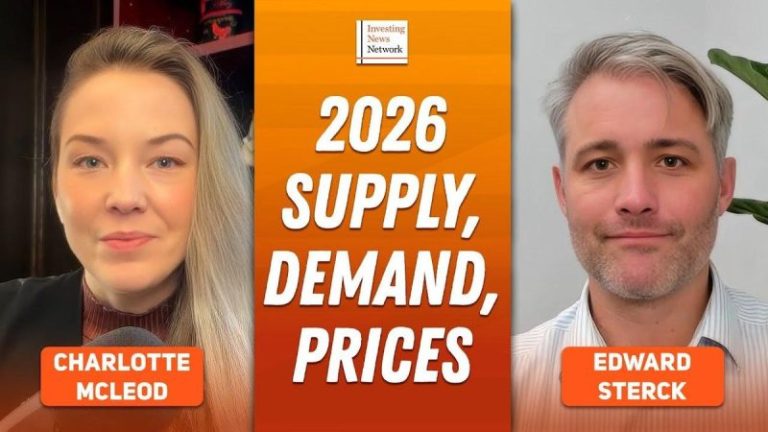
    Edward Sterck, director of research at the World Platinum Investment Council (WPIC), shares the organization’s platinum outlook heading into 2026.

    After a third consecutive deficit in 2025, the WPIC anticipates balance next year, but Sterck explained that there are factors that could change that outlook.

    Securities Disclosure: I, Charlotte McLeod, hold no direct investment interest in any company mentioned in this article.

    This post appeared first on investingnews.com