Rapid Critical Metals (RCM:AU) has announced Latest Intercepts Confirm Continuity Across Drill Program
Download the PDF here.
This post appeared first on investingnews.com

Rapid Critical Metals (RCM:AU) has announced Latest Intercepts Confirm Continuity Across Drill Program
Download the PDF here.
Sankamap Metals Inc. (CSE: SCU) (‘Sankamap’ or the ‘Company’) is pleased to announce that the Management Cease Trade Order (the ‘MCTO’) issued on October 29, 2025, by the Alberta Securities Commission (the ‘ASC’) has been revoked, effective February 4, 2026. The MCTO applied only to the Company’s CEO and CFO and did not affect trading by other shareholders, including the public.
The Company confirms that it has completed the filing of its annual audited financial statements, management’s discussion and analysis, and CEO and CFO certifications for the fiscal year ended June 30, 2025 (collectively, the ‘Required Filings‘), on January 29, 2026, and the filing of its interim first-quarter financial statements, on January 30, 2026.
Copies of the Required Filings and the interim first-quarter financial statements are available under the Company’s profile on SEDAR+ at www.sedarplus.ca.
About Sankamap Metals Inc.
Sankamap Metals Inc. (CSE: SCU) is a Canadian mineral exploration company dedicated to the discovery and development of high-grade copper and gold deposits through its flagship Oceania Project, located in the South Pacific. The Company’s fully permitted assets are strategically positioned in the Solomon Islands, along a prolific geological trend that hosts major copper-gold deposits; including Newcrest’s Lihir Mine, with a resource of 71.9 million ounces of gold¹ (310 Mt containing 23 Moz Au at 2.3 g/t P+P, 520 Mt containing 39 Moz Au at 2.3 g/t indicated, 81 Mt containing 5 Moz Au at 1.9 g/t measured, 61 Mt containing 4.9 Moz Au at 2.3 g/t Inferred).
Exploration is actively advancing at both the Kuma and Fauro properties, part of Sankamap’s Oceania Project in the Solomon Islands. Historical work has already highlighted the mineral potential of both sites, which lie along a highly prospective copper and gold-bearing trend, suggesting the possibility of further, yet-to-be-discovered deposits.
At Kuma, the property is believed to host an underexplored and largely untested porphyry copper-gold (Cu-Au) system. Historical rock chip sampling has returned consistently elevated gold values above 0.5 g/t Au, including a standout sample assaying 11.7% Cu and 13.5 g/t Au2; underscoring the area’s significant potential.
At Fauro, particularly at the Meriguna Target, historical trenching has returned highly encouraging results, including 8.0 meters at 27.95 g/t Au and 14.0 meters at 8.94 g/t Au3. Complementing these results are exceptional grab sample assays, including historical values of up to 173 g/t Au3, along with recent sampling by Sankamap at the Kiovakase Target, which returned numerous high-grade copper values, reaching up to 4.09% Cu. In addition, limited historical shallow drilling intersected 35.0 meters at 2.08 g/t Au3, further underscoring the property’s strong mineral potential and the merit for continued exploration. With a commitment to systematic exploration and a team of experienced professionals, Sankamap aims to unlock the untapped potential of underexplored regions and create substantial value for its shareholders. For more information, please refer to SEDAR+ (www.sedarplus.ca), under Sankamap’s profile.
1. Newcrest Technical Report, 2020 (Lihir: 310 Mt containing 23 Moz Au at 2.3 g/t P+P, 520 Mt containing 39 Moz Au at 2.3 g/t indicated, 81 Mt containing 5 Moz Au at 1.9 g/t measured, 61 Mt containing 4.9 Moz Au at 2.3 g/t Inferred)
2. Historical grab, soil and BLEG samples from SolGold Kuma Review June 2015, and SolGold plc Annual Report 2013/2012
3. September 2010-June 2012 press releases from Solomon Gold Ltd. and SolGold Fauro Island Summary Technical Info 2012
QP Disclosure
The technical content for the Oceania Project in this news release has been reviewed and approved by John Florek, M.Sc., P.Geol., a Qualified Person in accordance with CIM guidelines. Mr. John Florek is in good standing with the Professional Geoscientists of Ontario (Member ID:1228) and a director and officer of the Company.
ON BEHALF OF THE BOARD OF DIRECTORS
s/ ‘John Florek’
John Florek, M.Sc., P.Geol
Chief Executive Officer
Sankamap Metals Inc.
Contact:
John Florek, CEO
T: (807) 228-3531
E: johnf@sankamap.com
The Canadian Securities Exchange has not approved nor disapproved this press release.
Forward-Looking Statements
Certain statements made and information contained herein may constitute ‘forward-looking information’ and ‘forward-looking statements’ within the meaning of applicable Canadian and United States securities legislation. These statements and information are based on facts currently available to Sankamap and there is no assurance that the actual results will meet management’s expectations. Forward-looking statements and information may be identified by such terms as ‘anticipates,’ ‘believes,’ ‘targets,’ ‘estimates,’ ‘plans,’ ‘expects,’ ‘may,’ ‘will,’ ‘could’ or ‘would.’ Forward-looking statements are subject to various risks, uncertainties, and other factors that could cause actual results or events to differ materially from those expressed or implied by such statements. Sankamap does not undertake any obligation to update forward-looking statements or information, except as required by applicable securities laws. For more information on the Company, investors should review the Company’s continuous disclosure filings that are available at www.sedarplus.ca.
To view the source version of this press release, please visit https://www.newsfilecorp.com/release/282944
News Provided by TMX Newsfile via QuoteMedia

Gold took center stage at this year’s Vancouver Resource Investment Conference (VRIC), coming to the fore in a slew of discussions as the price surged past US$5,000 per ounce.
Held from January 25 to 26, the conference brought together diverse experts, with a focus point being the ‘Gold Forecast’ panel hosted by Daniela Cambone, global media director and lead anchor at ITM Trading.
The panel brought together GoldMining (TSX:GOLD,NYSEAMERICAN:GLDG) CEO and co-founder Alastair Still, Gold Royalty (NYSEAMERICAN:GROY) chair and CEO David Garofalo, Von Greyerz partner Matthew Piepenburg, ‘Rich Dad Poor Dad’ author Robert Kiyosaki and Incrementum partner Ronald-Peter Stöferle for a wide-ranging discussion.
Gold’s price gains through 2025 and into early 2026 have been driven by several factors. One of the most impactful has been ongoing purchases by central banks around the globe.
According to the World Gold Council’s latest gold demand trends report, central banks bought a total of 863 metric tons of the precious metal last year. While the amount falls short of the more than 1,000 metric tons purchased in each of the past three years, it remains well above historical averages.
Both the World Gold Council and the VRIC panelists believe that central bank buying of gold will remain elevated in 2026, providing critical support for the yellow metal’s price.
Behind these movements is a desire to diversify foreign reserves away from US-dollar-denominated assets such as treasuries. Once considered a stable and reliable investment for central banks, high deficit spending and trillions in debt have dulled the luster of these instruments over the past two decades.
Adding to a deterioration in confidence are US actions following Russia’s invasion of Ukraine in 2022.
“Since 2014, central banks have been net selling US treasuries and net stacking gold, which became exponential when the US dollar was weaponized against Russia,’ Piepenburg said.
‘Weaponizing a neutral reserve asset was a big no-no in terms of respect, trust and admiration for an already overly issued and indebted US treasury, and by proxy, US dollar,’ he added.
However, Piepenburg was clear that he doesn’t see this accumulation of gold by central banks as a move away from the US dollar, but more as a means to prepare for a repricing of the dollar.
He also believes there will be greater usage of gold as a net settlement asset.
For his part, Garofalo said that the US debt-to-GDP ratio over the past 50 years has climbed to 350 percent, up from 100 percent in the 1970s. It has created a tricky situation for the US Federal Reserve, which must walk a fine line between how high it can raise interest rates without triggering a significant currency reset. Overall, US debt of over US$34 trillion, combined with trillions in annual deficit spending, is eroding central banks’ confidence in holding US debt.
Garofalo went on to explain that gold isn’t a commodity; its value isn’t driven by supply and demand fundamentals.
“It’s a monetary instrument, and monetary instruments stay relative to each other based on relative interest rates. So it’s that lack of confidence that’s really driving capital out of sovereign debt into central banks by Tether, by individuals, into gold as a monetary instrument,” he said.
The panelists also pointed to interest in gold from stablecoin issuers.
For example, Tether now holds 16 metric tons of gold in reserves, worth over US$2.5 billion.
“Issuers of these stablecoins give citizens their electronic dollar, the issuers then take that dollar to buy US treasuries — good for Uncle Sam — they then arbitrage the yield on those treasuries for themselves and take a profit. The key thing to look at with Circle Internet Group (NYSE:CRCL), Tether or JPMorgan Chase (NYSE:JPM) is that they’re taking the profits from the stablecoin and they’re buying gold. That’s the great irony,” Piepenburg said.
He explained that stablecoins were introduced to support the US dollar, but creators have since added new products backed by gold, which is fundamentally more stable than fiat currencies.
Overall, Piepenburg and Garofalo agreed that the crypto market’s entry into gold is a positive sign and will catalyze consolidation in the sector’s business side, while also making it more accessible to investors.
“Having another player, another pool of capital that traditionally has not been in the space, is part of the same phenomenon that’s driving generalists for the first time in many decades back into our sector,” said Garofalo.
The panel made several key points that should be important to investors.
With gold’s historic run, some investors are worried that they missed the boat and now it’s too expensive.
Cambone asked Garofalo about this issue, noting that investors need to learn to focus more on gold’s role as a stable store of value and recognize the erosion of fiat currencies.
“Every fiat currency ever created has ultimately failed, and the US dollar will too. It’s like that saying about bankruptcy, it happens gradually and then suddenly,’ Garofalo said.
‘That’s what’s going to happen with the US dollar — that erosion of trust will be settled.’
Although the panelists agreed that the gold bull market will end at some point, none believe that will happen soon. They noted that the drivers of the current market show no signs of abating.
US foreign and trade policy has emphasized traditional western trade alliances and has pushed Russia, China and the rest of the BRICS nations to distance themselves from the US dollar.
This is in addition to a looming debt crisis in several major economies, especially in the US.
It’s not to say that the group was advocating jumping directly on the bandwagon — they also agreed that investors could expect a significant pullback in gold, an event that occurred just days after VRIC ended.
However, they stressed the importance and safety of holding gold-linked assets during the current cycle.
This could be in the form of physical gold or exchange-traded products. They also noted that, due to gold’s price run, the junior exploration sector has seen a resurgence.
Garofalo said juniors have spent years severely undercapitalized. “Gold reserves in the ground have declined 40 percent since 2012,” he said, adding, “We can’t turn on supply to meet the increased gold price. All we can do is mine lower-grade material that otherwise would have been wasted on a lower gold price environment.”
His sentiment was echoed by Still, who sees a wave of mergers and acquisitions coming as industry majors look to fill pipelines. “If you’re a major producer, you’re trying to find gold; it might take you five or 10 years to find it. You’re going to spend millions to do so. Or do you go buy it from a junior explorer or developer?” he said.
Still explained that on a per-ounce basis, the cost to buy a company that’s put in the exploration and development work is likely cheaper than conducting the exploration themselves.
With various options available to investors seeking exposure to gold, the discussion turned to price forecasts.
Garofalo was blunt when he stated US$7,000, while Piepenburg was slightly more nuanced.
“I think we’re only halfway through an eight year cycle in gold, so you could see US$7,000, US$8,000, but that’s notwithstanding the unforeseeable legislative or other black swans,’ he said.
‘Based on fundamentals, gold’s direction, secular, is north,” he said.
Securities Disclosure: I, Dean Belder, hold no direct investment interest in any company mentioned in this article.

Brazilian rare earth producer Serra Verde Group has reportedly offered the United States an option to take a minority stake in the company as part of a newly expanded financing package, according to Bloomberg.
The move comes as Serra Verde finalized a US$565 million loan with the US International Development Finance Corporation (DFC), roughly 22 percent higher than the amount initially approved by the agency’s board last year. The expanded financing is aimed at supporting the company’s ongoing development and scaling of its rare earth operations.
Serra Verde is Brazil’s only producing rare earth miner and operates a long-life deposit rich in both heavy and light rare earth elements (REEs), including neodymium (Nd), praseodymium (Pr), terbium (Tb) and dysprosium (Dy). These elements are critical for permanent magnet production and have applications across defense, aerospace, nuclear, and other advanced technologies.
Founded to develop Brazil’s rare earth resources, Serra Verde has positioned itself as a potential strategic supplier for Western supply chains seeking alternatives to Chinese dominance in the sector.
The potential US minority stake would reflect Washington’s broader push to secure access to critical minerals and reduce dependence on foreign suppliers amid increasing global competition for strategic resources.
As part of the final terms, the DFC received an option to acquire a minority equity stake in Serra Verde, without any role in management.
“It is an option for the U.S. government to take a minority stake in the company, with no role in management,” CEO Ricardo Grossi said in an interview, adding that discussions with the DFC have been underway for roughly 18 months.
The financing comes just weeks after the Trump administration unveiled plans for Project Vault, a proposed US strategic stockpile of critical minerals aimed at insulating manufacturers from supply disruptions.
The initiative would combine private capital with a US$10 billion loan from the US Export-Import Bank to procure and store materials such as rare earths, lithium, and cobalt.
“We view the initiative positively, as it could be a way to bring forward revenue for early-stage projects and help buy time until rare earth separation plants outside Asia mature,” Grossi said, but clarified that discussions are still preliminary.
Grossi also confirmed that Serra Verde is renegotiating offtake contracts previously signed with Chinese customers. Those agreements are expected to conclude by year end, potentially clearing the way for supply deals with Western manufacturers.
Brazil holds the largest rare earth reserves outside China, and Serra Verde is currently the country’s only producer.
The Pela Ema deposit contains both light and heavy rare earth elements, including neodymium, praseodymium, terbium, and dysprosium, which are critical for permanent magnets used in electric vehicles, wind turbines, electronics and defense systems.
Serra Verde began commercial production in 2024 and is targeting annual output of 6,500 metric tons of total rare earth oxides by the end of next year. The company is also evaluating options to double production capacity within the next four years.
The deal also places Serra Verde among a growing list of rare earth and critical minerals companies receiving direct backing from Washington.
Securities Disclosure: I, Giann Liguid, hold no direct investment interest in any company mentioned in this article.
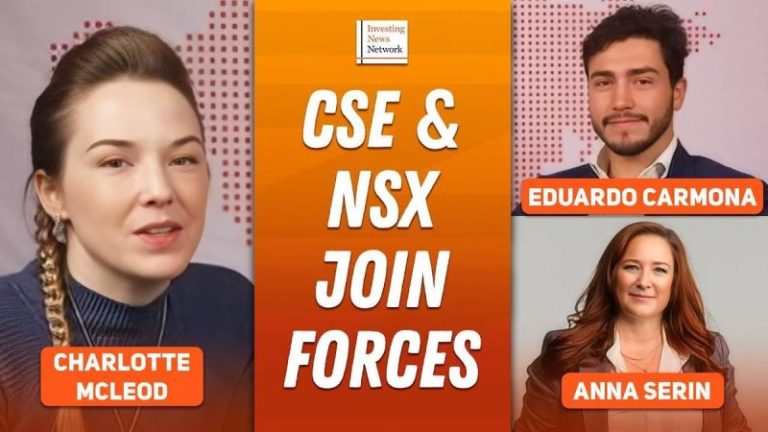
Anna Serin of the Canadian Securities Exchange (CSE) and Eduardo Carmona of the National Stock Exchange of Australia (NSX) discuss the CSE’s recent acquisition of the NSX, outlining what it means for both companies and investors.
‘What we’re hoping to create, and where we think the opportunity lies in Australia, is creating the venture market a little bit like the CSE’s done (in Canada),’ Carmona explained.
Securities Disclosure: I, Charlotte McLeod, hold no direct investment interest in any company mentioned in this article.

For investors who want to gain exposure to artificial intelligence stocks, exchange-traded funds (ETFs) are a popular avenue, because AI ETFs allow investors exposure to the overall market rather than individual AI stocks.
AI investing has exploded in popularity in recent years, particularly with the proliferation and advancement of generative AI technology. Today, many of the world’s largest tech stocks are focused on increasing their AI capabilities, or developing and supplying the hardware and technology needed to support the industry.
However, the sector has a long history. The phrase ‘artificial intelligence’ has been around since 1955, when it was used to describe a new computer science subdiscipline. Today, we use AI to describe simulated intelligence in machines. In other words, machines with AI are capable of simulating thinking like people and mimicking their actions.
As applications for AI rapidly expand, it’s clear that this market isn’t going away anytime soon.
Assets under management: US$7.97 billion
The Global X Artificial Intelligence & Technology ETF is passively managed, tracking the Indxx Artificial Intelligence & Big Data Index. The Global X fund, which was established in May 2018, has an expense ratio of 0.68 percent.
‘AIQ is passively managed to invest in developed market companies that are involved in the use of artificial intelligence to analyze big data, whether for their own operations, as a service to other companies, or through the production of related hardware,’ according to ETF.com.
The Global X Artificial Intelligence & Technology ETF’s 87 holdings include Samsung Electronics (KRX:005930), Alphabet (NASDAQ:GOOGL) and Micron Technology (NASDAQ:MU).
Assets under management: US$3.67 billion
The Defiance Quantum ETF launched in September 2018. It tracks an index composed of 84 companies that derive at least half of their annual revenues from quantum computing and machine learning technology development activities.
The fund has the lowest expense ratio of the five AI funds on this list at 0.4 percent.
Some of the ETF’s top holdings include Quantum Emotion (TSX:QNC), Micron Technology and MKS (NASDAQ:MKSI).
Assets under management: US$1.04 billion
The newest addition to this list, the Dan Ives Wedbush AI Revolution ETF launched on June 4, 2025, as Wedbush Fund’s inaugural ETF. The ETF’s holdings are based on the research of Dan Ives, Wedbush’s Global Head of Technology Research, and on the IVES AI 30 list, which is updated on a quarterly basis. It has an expense ratio of 0.75 percent.
The Dan Ives Wedbush AI Revolution ETF has 32 holdings comprising mostly large-cap tech stocks based in North America. Its top holdings include Micron Technology, Taiwan Semiconductor Manufacturing Company (NYSE:TSM) and NVIDIA (NASDAQ:NVDA).
Assets under management: US$1.036 billion
The Roundhill Generative AI & Technology ETF launched on May 13, 2023, and focuses on companies that will benefit from the growth of generative AI. Companies must derive 50 percent of their revenue from generative AI or tech to qualify for its portfolio.
This AI ETF is actively managed and does not track an index. It has an expense ratio of 0.75 percent.
The ETF has 49 holdings, with 98 percent being large-cap companies. Its top holdings include Alphabet, NVIDIA and Microsoft (NASDAQ:MSFT), and it offers exposure to North American and Asian tech firms.
Assets under management: US$715.8 million
The last AI ETF on this list is the Invesco AI and Next Gen Software ETF. It is the longest running compared to the other ETFs on this list, having launched in June 2005. The fund has an expense ratio of 0.58 percent.
It is based on the STOXX World AC NexGen Software Development Index and tracks the performance of companies that derive a direct revenue from technologies or products that contribute to future software development.
The Invesco AI and Next Gen Software ETF’s 100 holdings include Micron Technology, Meta Platforms (NASDAQ:META) and Advanced Micro Devices (NASDAQ:AMD).
Securities Disclosure: I, Lauren Kelly, hold no direct investment interest in any company mentioned in this article.

The U.S. Equal Employment Opportunity Commission said Wednesday that it is investigating Nike for allegedly discriminating against white workers.
The agency that polices discrimination in the workplace filed an action in federal court in Missouri to compel the publicly traded athletic shoe and apparel giant to produce information in response to a subpoena the agency served on the company last fall, according to court filings reviewed by NBC News.
The EEOC said it was investigating allegations that the company’s mentorship and training programs and its personnel decisions gave nonwhite employees preferential treatment that amounts, according to the agency, to discrimination against white workers.
Nike is the world’s largest sportswear and apparel company, with nearly 80,000 employees and revenues of around $51.4 billion in 2024.
The allegations were not made by workers at Nike who believed they had been the targets of unfair treatment, however, as is typically the case in EEOC investigations.
Instead, the court filings show that this case stems from a commissioner’s charge brought by then-commissioner Andrea Lucas herself in May 2024, and based on publicly available information such as Nike’s own annual “Impact Reports” and information on its public website.
The EEOC’s request that a judge enforce the subpoena is the latest instance of the Trump administration using a federal agency that is typically charged with preventing and responding to discrimination against nonwhite Americans, and deploying it instead to protect what it says are the underrepresented interests of white people.
Nike has objected in court to many of the EEOC’s demands to documents over the last several months, arguing that they are vague, overly broad, and seek information dating back to well before the period in question.
“This feels like a surprising and unusual escalation,” a Nike spokesperson said. “We have had extensive, good-faith participation in an EEOC inquiry into our personnel practices, programs, and decisions and have had ongoing efforts to provide information and engage constructively with the agency.”
The spokesperson added that Nike has shared “thousands of pages of information and detailed written responses” in connection with the agency’s inquiry and said the company is in the “process of providing additional information.” Nike will respond to the agency’s petition, the spokesperson said.
Lucas was appointed chair of the EEOC by President Donald Trump in November 2025 after serving as a commissioner since 2020, when the president nominated Lucas to the agency.
The agency said it filed the subpoena enforcement action after “first attempting to obtain voluntary compliance with its investigative requests.”
The US Department of State held its first Critical Minerals Ministerial on Wednesday (February 4), drawing together officials from more than 50 countries in Washington, DC.
The initiative is geared at challenging China’s dominance in critical minerals supply chains, and comes just two days after the US announced plans for a US$12 billion critical minerals stockpile called Project Vault.
Offering opening remarks at the ministerial were: Vice President JD Vance; Secretary of State Marco Rubio; Japanese State Minister for Foreign Affairs Horii Iwao; Special Assistant to the President of the US and Senior Director for Global Supply Chains David Copley; and Under Secretary of State for Economic Affairs Jacob Helberg.
Chief among the topics they discussed was the establishment of a preferential critical minerals trade zone with ‘enforceable’ price floors maintained by tariffs.
Vance framed the initiative as a way to prevent domestic critical minerals producers from being undercut by cheap foreign supply sources, saying preferential trade zone prices will stay consistent.
Here’s a look at five key quotes on critical minerals from the event.
‘And as much as we talk about the modern economy, the digital economy, the high-tech economy, the President said something that was very, very important, and I think should inform a lot of how we think about future growth, which is that as much as data centers and technology and all of these incredible things that we’re all working on matter, fundamentally you still have an economy that runs on real things. And there is no realer thing than oil — and I would add to that there’s no realer thing than critical minerals.’
‘So, this morning, the Trump Administration is proposing a concrete mechanism to return the global critical minerals market to a healthier, more competitive state — a preferential trade zone for critical minerals, protected from external disruptions through enforceable price floors. We will establish reference prices for critical minerals at each stage of production, pricing that reflects real-world, fair-market value.
‘And for members of the preferential zone, these reference prices will operate as a floor, maintained through adjustable tariffs to uphold pricing integrity. We want to eliminate that problem of people flooding into our markets with cheap critical minerals to undercut our domestic manufacturers because we know, of course, that as soon as they’ve undercut our domestic makers, they — the domestic markers — they’d leave the market and the people who undercut them then jack up the price to a completely unfair level. We’re going to fix that problem.’
‘The United States used to produce its own critical minerals and derivative products like rare earth magnets. Back in 1949, miners in Mountain Pass, California discovered one of the world’s richest mineral deposits. By 1952, the United States, we were mining rare earths there, and that discovery sparked a revolution.
‘American scientists and engineers, alongside innovators from many of the countries that are here today, rushed to discover new applications for these minerals and, with these new technologies, ushered in the jet age, we ushered in the space age, we ushered in the computer age.
‘And then we became blinded, blinded by the potential of the technologies those metals enabled, but we neglected their importance. Mining is less glamorous than building computers. It’s less glamorous than building cars or airplanes. But building computers and cars and airplanes is less glamorous than designing them.
‘As we embraced what was new and glamorous, we outsourced what seemed old and unfashionable. We allowed, for example, Mountain Pass — and with it, most of America’s critical mineral industry — to wither and to die so that we could focus on manufacturing. Then we outsourced the manufacturing.
‘And I know this is a story I’m telling, but it’s a story many of the advanced economies represented here today understand well. We outsourced the manufacturing so we could focus on designing these goods. And then one day we woke up and we realized we had outsourced our economic security and our very future. We were at the mercy of whoever controlled supply chains for these minerals. So my hope is that we are gathered here today as the first but important step to rectifying this mistake, to bring together our collective talent for innovation, when our advantage over rivals — where our advantage over rivals has only grown, and to apply it to bringing back manufacturing and reopening mines here in the United States, but also in all the partner nations represented here today.’
‘Japan strongly believes that FORGE will become an important venue and a vehicle for us to focus on supply chain diversification and ensure policy coordination. Japan stands ready to actively contribute to discussions to further deepen collaboration with partners and to ensure the effective implementation of this initiative.
‘So how should we move forward from here? On the supply side, diversification is essential. Diversity as opposed to concentration is what makes us resilient. This has to be one of the — our major guiding principles.’
‘So, four key initiatives — we’re investing, we’re stockpiling, we’re going to protect our mining companies, and we’re fixing our mining ecosystem — because this industry is so important to our national development, as I know it is to your countries as well. But most importantly, under President Trump’s leadership, we are no longer standing around admiring the problem. We’re not spending our time writing 200-page book reports about how important critical minerals are. We have a plan, and we’re focused on project execution — getting deals done, getting companies their permits, stockpiling minerals, and hopefully moving forward with all of you, our international partners, to protect our mining companies and to rebuild global mining in a fair and balanced way.’
Securities Disclosure: I, Charlotte McLeod, hold no direct investment interest in any company mentioned in this article.

South Harz Potash Limited (SHP:AU) has announced Ongoing progress at Glava-Klinten and Torsby West
Download the PDF here.